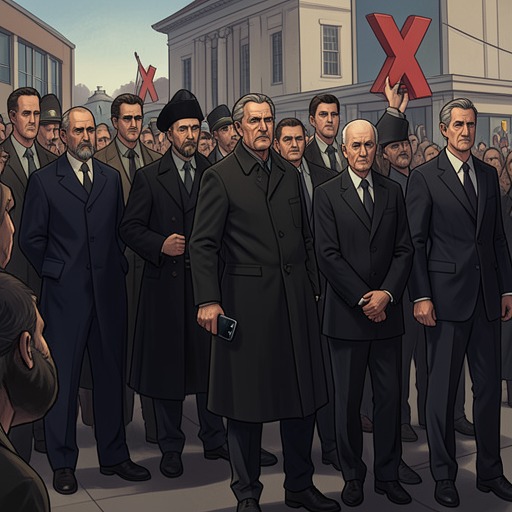
Burnage Celtic Crew
Blow OutThe Burnage Celtic Crew is a Manchester drug gang drawn into the investigation of Ronnie O’Neill’s murder through its conflict with the O’Neill family. Its leader, Ryan Walsh, seeks police protection after Ronnie’s death, and the possibility that the Crew was responsible for the killing becomes one strand of the inquiry. The gang’s role also gives the murder an immediate public-safety dimension: investigators must pursue the killer while trying to prevent retaliation from escalating into wider gang violence.
Identity and Position
The Crew is identified as one of the drug gangs targeted by police disruption efforts. Its leader, Ryan Walsh, is known to investigators before he appears seeking protection, and his gang’s name is already on a list supplied to the murder team. This places the Crew within a wider landscape of competing organizations whose activities and relationships matter to the investigation, rather than making it an incidental suspect group.
The gang’s name surfaces as Jo Stuart speaks with Nigel Fox, a detective chief inspector who reports that a gang leader has come to his office demanding protection from the O’Neill family. When Jo identifies Walsh as the leader of the Burnage Celtic Crew, Fox confirms that she has correctly recognized the organization. Nick Carter checks the team’s folder and finds Walsh at number five on the list, linking the immediate protection request to information already assembled for the case.
Territorial Conflict and Motive
The proposed connection between the Crew and Ronnie O’Neill’s murder grows out of a dispute over territory. According to Fox, Walsh had gradually taken over some of the O’Neills’ territory while Ronnie was imprisoned. Ronnie had begun trying to reclaim it, giving the two organizations a concrete commercial and territorial point of conflict.
Fox reports that street talk holds the O’Neills responsible for blaming Walsh for Ronnie’s death. The same reports suggest that the family may abduct and harm him, and that they have warned members of the Crew to keep their heads down if they wish to avoid a similar fate. These are reports of threats, not confirmation that the O’Neills have acted on them; nevertheless, they indicate why Walsh asks the police for protection and why the investigation cannot treat the murder as an isolated crime.
The territorial history also supplies a possible motive for the Crew. Fox says Ronnie’s death could be interpreted as a pre-emptive strike by the Burnage Celtic Crew, given Walsh’s encroachment and Ronnie’s attempt to recover ground. That possibility remains a theory, not a finding. Jo contrasts it with the manner of the murder: the use of a slow-acting poison seems to her more personal than businesslike. The tension between those interpretations keeps the gang’s potential involvement open without establishing its guilt.
Police Response and Wider Stakes
The prospect of retaliation turns the inquiry into a matter of managing relations among several gangs as well as identifying a killer. Helen Gates warns that the murder could provoke a vigilante conflict and evoke Manchester’s former reputation as “Gunchester.” Political attention, press scrutiny, and pressure on police leadership compound the risk. The stated priority is to prevent the O’Neill organization from trying to avenge Ronnie and to stop other gangs from exploiting the situation.
Jo’s assignment is therefore framed alongside a broader de-escalation effort. While her team is tasked with catching Ronnie’s killer, Operation Challenger and Operation Xcalibre are to concentrate on calming the situation among the gangs. The Burnage Celtic Crew matters to that effort both as an organization that may be threatened by the O’Neills and as a possible participant in the original crime. Its place in the story exposes the difficult overlap between investigation and prevention: the police must evaluate an unconfirmed gang motive without allowing suspicion, threats, or retaliation to become a new cycle of violence.
Narrative Role
The Crew functions as a plausible line of inquiry that arises from evidence about territory and circulating reports, but the available account does not resolve whether it had any part in Ronnie’s murder. Its connection to Walsh’s request for protection makes the consequences of the killing visible beyond the victim and his family; its conflict with the O’Neills also gives investigators a credible alternative to a purely personal motive.
That uncertainty is central to the organization’s narrative role. The police must distinguish what is known—the competing claims over territory, Walsh’s approach for protection, and reported threats—from what remains an interpretation of the murder. The resulting pressure is twofold: pursue the case through evidence while preventing a disputed explanation from becoming the trigger for a wider gang war.